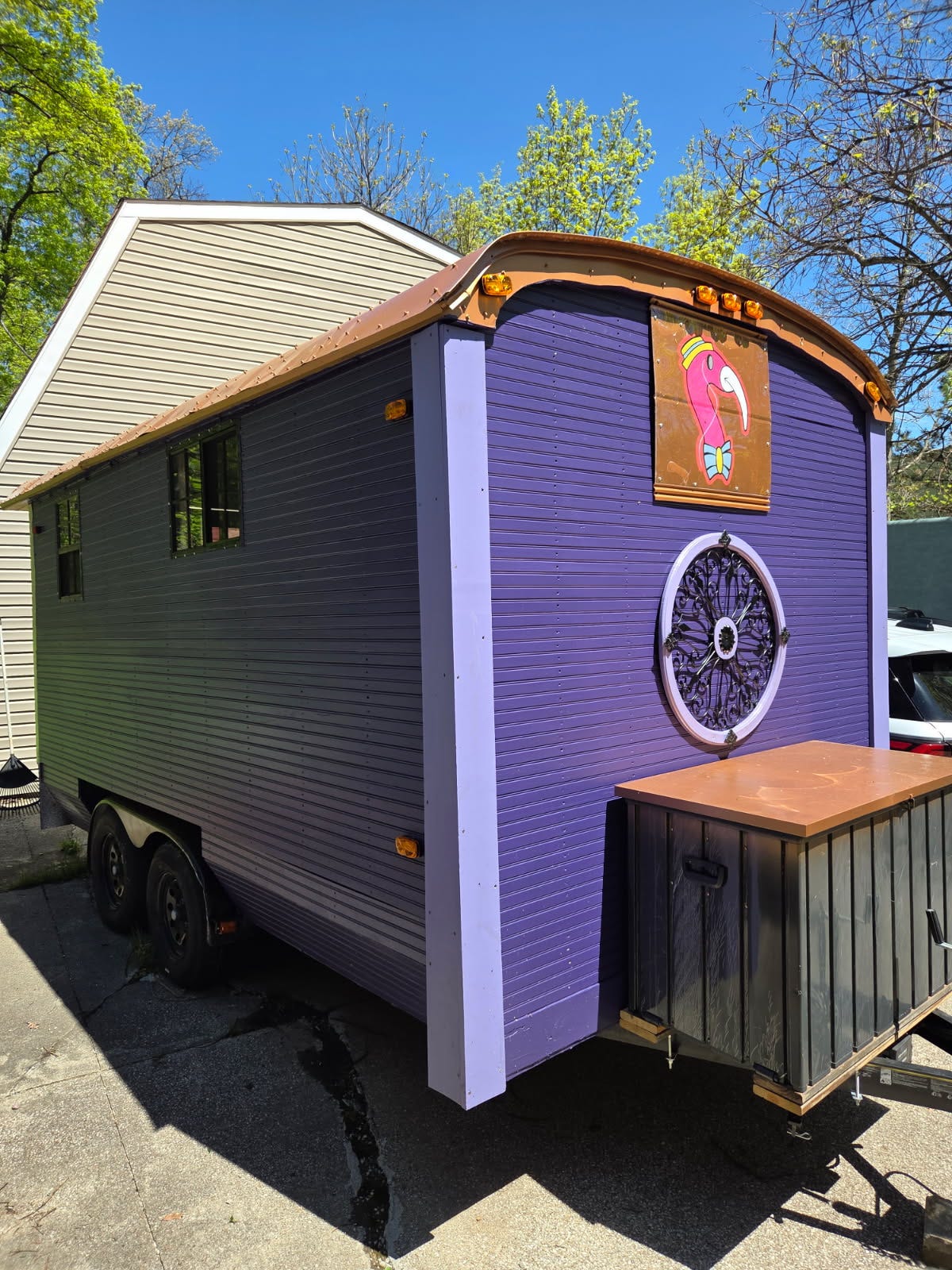
This piece exposes the ongoing exploitation, extraction and erasure of Roma and Sinti people in the Americas. It is a direct response to the publication of The Romani Atlantic by Cambridge University Press—a project that appropriates gadje (non-Roma) narratives and frameworks to re-colonize our culture, our scholarship and our lives.
For generations, the gadje world has accused the Roma of kidnapping children, pickpocketing wealth, stealing culture. But as the anti-fascist maxim states: every accusation is a confession.
My name is Russell Patrick Brown. I am a Bashaldo Gypsy whose family’s history reaches through the roads of America for generations. My thesis for my master’s degree at NYU focused on dance in 18th-century Atlantic history (2013-2015), and I recently had my PhD at the University of Limerick accepted without corrections. In it, I discovered the hidden, traumatic history of impact-driven dance in the Atlantic world—more commonly known as percussive dance. I have published on early modern maritime dance and the history of harm in wooden shoes. Yet, I am writing to you from exile. I have lost my home of 15 years, I had to flee my life and career as a software engineering manager for America’s largest publisher due to the corruption I am confronting in this case, I do not know when I will see my family again, and I have been pushed out of the very academic territory I helped map.
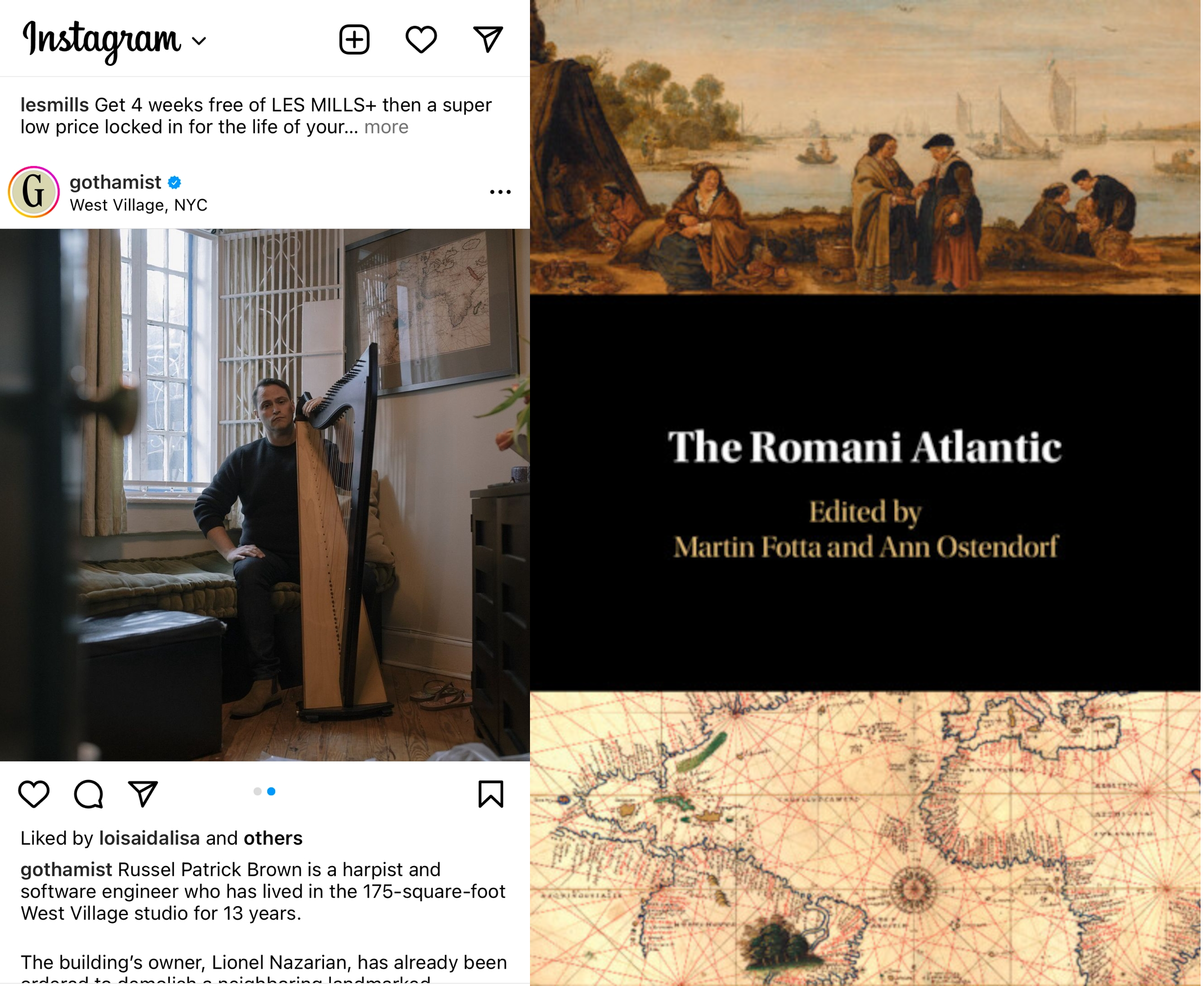
While I was fighting a brutal housing crisis in court to save my West Village apartment—a historic hub of Romani memory once home to Romany Marie’s cafe at 20 Christopher Street—institutional colleagues were finalizing a “field-defining” book. Look closely at the cover of The Romani Atlantic, and then look at the map hanging on the wall of my apartment (since 2014) in this viral Gothamist feature about my pending eviction from my rent-stabilized apartment as the last legal tenant in 14-18 Gay Street in the Greenwich Village of New York City.
Whether intentional or symbolic, the extraction is complete. The institution took the map from my wall, the archival labor from my hands, and left the living Romani scholar in exile. They write about the “Atlantic world” as an abstract playground of text, while active colonization displaces the physical, living bodies of the people they study. Ironically, it is my own Atlantic world of allies—and fellow Roma and non-Roma across Europe, Africa and South America—offering literal and intellectual refuge to me in this crisis.
I met and got to know these researchers with the belief that we would work together. I believed that I had the knowledge, they had the power, and this would be shared. Now, they have some knowledge, I still have no power and they no longer think they need me. A war came to my door, stole my home and then the wolves came. I had expected that I was collaborating with a project to reclaim Romani and Sinti history and culture for Romani and Sinti people. I had not expected that it would climax into our literal erasure and for the timetakers, as I call them, prestige for the next thirty years.
The Real Vampires and Bohemian Groves
Dear Traveler,
Come sit with me by the fire while we talk of monsters and other perils on the road ahead. It starts with children going missing, then entire peoples are murdered and then memories are altered overnight. What evil could do such a thing?
There has been a lot of talk through towns, trains and way stations of vampires—those half-dead, half-alive who feast upon the blood of helpless victims. They may be well-mannered, of fair complexion and smile, but at night they are beasts of incredible force, mind manipulation and seduction that feasts upon the innocent. And innocent here does not just refer to the sexually inexperienced. It’s those whose hearts remain unsullied by greed and hate, braving to bear their souls in a cruel world. They are a vampire’s delight. They are a meal to be sucked dry and discarded before the next victim is sacrificed to a hunger with no end.
Irish gothic writer Sheridan Le Fanu gave us the vampire Carmilla in 1872 and Bram Stoker gave us the famous Dracula in 1897, but before that, the Roma had our own lore that helped us at our own fires understand the perils of a world where it is not safe to be human. We know genocides, ethnocides and other horrors await us as well as others who cherish the precious ancient arts of music, dance, craft and story, and are unwilling to be ruled by insatiable greed without honor.
In our languages, yes, we have many words for people who harm others for their own gain. We know beasts are at large and many are in charge corrupting the truth, such as Stoker’s version of Dracula and its many re-tellings: our own lore is used against us as we are portrayed not as brown people vulnerable to pale-faced monsters, but as Dracula’s servants.
We see a similar manipulation of the truth—that it is us Roma who are stealing children and not the other way around—in Stephen King’s Doctor Sleep (2013). There, Gypsy aesthetics and traditions are used to create “The True Knot,” a nomadic group of psychic vampires whose immortality comes from devouring the torturous pain of children with paranormal abilities. In the wake of the partial release of the Epstein Files by the US FBI and all of its purported horrors including child sacrifice, their accusations look like projection.
This perverse dynamic expands far beyond pop culture; it anchors the architecture of elite gadje power itself. Look no further than the infamous Bohemian Grove, where the world’s most powerful politicians, billionaires and imperial architects retreat into the California redwoods. They call themselves “Bohemians,” mimicking a stolen caricature of Romani freedom, camping under a giant stone owl to perform theatrical rituals and broker backroom deals that govern global empires. It is the ultimate manifestation of the colonizer playing dress-up. They drape themselves in the aesthetic of the free-spirited traveler to obscure the greed and destruction they leave in their wake.
The colonization of Roma and Sinti culture has always depended upon blaming us for what the empire was doing. In the case of child kidnapping, scholar Noémie Ndiaye calls this a “perverse inversion of the historical realities of early modern human trafficking” (2022).
Vampires, egregores, secret networks, colonizers, narcissists, racists….whatever they are….they either lack humanity, or are not human at all. I will leave it up to brilliant psychologists and essayists to make those claims. As a Bashaldo Gypsy working with Roma and Sinti from around the world, I have confirmed that our culture is not about the exotic stereotypes so often imposed upon us by the gadje. It is about preserving who we are, remembering our humanity and protecting ourselves from those who have lost it.
500 Years of Silent Survival
For us Roma in the Americas, our history here began with Christopher Columbus’s third voyage in 1498, when Spanish Roma were transported to the colonies as forced laborers. This marked the beginning of a 500-year history in the Americas, which was defined by its own distinct perils and hardships that often mirrored, or even worsened, the systemic persecution left behind in Europe.
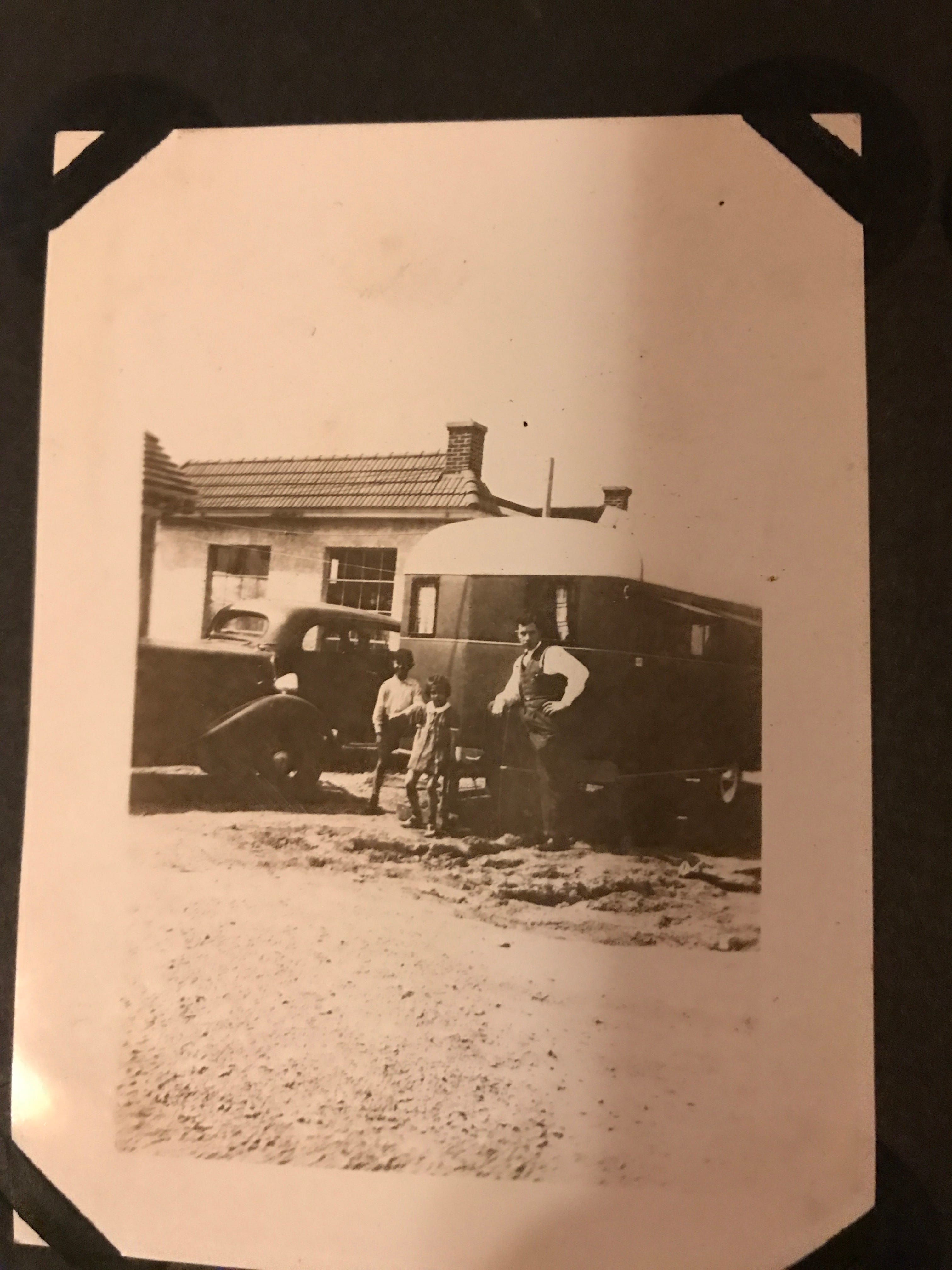
There is so much that can be said about our history, but I am asking you to notice one thing about this that is the subject, the object and the curse of not only this piece, and of the broader field of Romani studies in the Americas, but of my life: we, American Gypsies, have not been allowed to study it or tell it.
We have had gadje scholars and artists make enormous fortunes and careers at our expense. We have had Roma scholars from Europe come and tell our story. We have had first-generation Romani US Americans publish their stories, which is an absolute wonder that even happened. But those of us who have been here, who have survived generations of horrors, we remain silenced.
In the American case, the empire has always depended upon appropriating not just our culture, but our ways of creating culture amidst survival as a means of propagating the colonial project. Simply put, colonization loves to play dress-up as us. It drapes itself in the hardship and joys of travel, our ingenuity, our aesthetic, our music and our spiritual knowledge as a means to hide what is really happening: colonization. And few notice when it is pretending to be us. It is a choreography of occupation, and it spreads fast among gadje in its every permutation.
Let me be clear: if you claim to represent the Roma and Sinti in the Atlantic world and you are not advocating for our rights in the USA—which controls the hemisphere—you are not our friend. The Harvard FXB Center for Health and Human Rights did an unprecedented study on Roma in the US, and we even saw the passing of a house bill for the preservation of culture, but where did the rest of the institutional momentum and funding go?
Why are we not legally recognized and protected within the USA?
Why are there no departments led by Romani people where other Romani Americans and Roma from around the world can go to study and find sanctuary?
Why are Sinti Americans always erased, including by Romani scholars?
Why are “gypsy laws” on the books all over the country, and why are funded, comfortable scholars who profited and still profit from our suffering not doing anything to strike them down?
We survived a system that was not built for us, but built upon us. They have studied our every move, our every lesson since we arrived as slaves. They do not let us tell of our roads and our dancing masters of the 17th and 18th centuries. They do not let us talk about how Charlie Chaplin was Romani and shifted American media away from its chief entertainment, Blackface, and gave us the “tramp” and other embodied physical delights undeniably extending from our culture.
They do not do so because we are in the spine of how the empire replicates itself for its own expansionist dreams. For a long time, the scholarship of Ian Hancock set us on a particular course of purity tests—using European standards to dictate who we are versus what we have actually survived and what we have carried across the Atlantic. We deserve to speak and study ourselves on our own terms, and I believe the American gadje public should know this is actively being suppressed and stolen.
The Institutional Feast
The academic world knows that a century after the Gypsy Lore Society feasted on our families, the dinner bell has rung over racism and fascism once again. It is time for elite universities to dine on us yet again.
With an Oxford Handbook of Romani History scheduled for 2028, the institutional cement is currently being poured. Gatekeepers are deciding right now who gets to control the narrative—and where the foundational, long-term administrative salaries and institutional chairs will be anchored for the next thirty years. There is hope Romani scholars will be involved, but to what extent they will be able to tell their and our stories, and on what terms, remains to be decided. In my current experience collaborating with these scholars, my greatest fear is more token representation and exploitation, and—at best—that our voices will be framed entirely on gadje terms. As the majority of historians published and publishing are gadje, there is little hope without serious change.
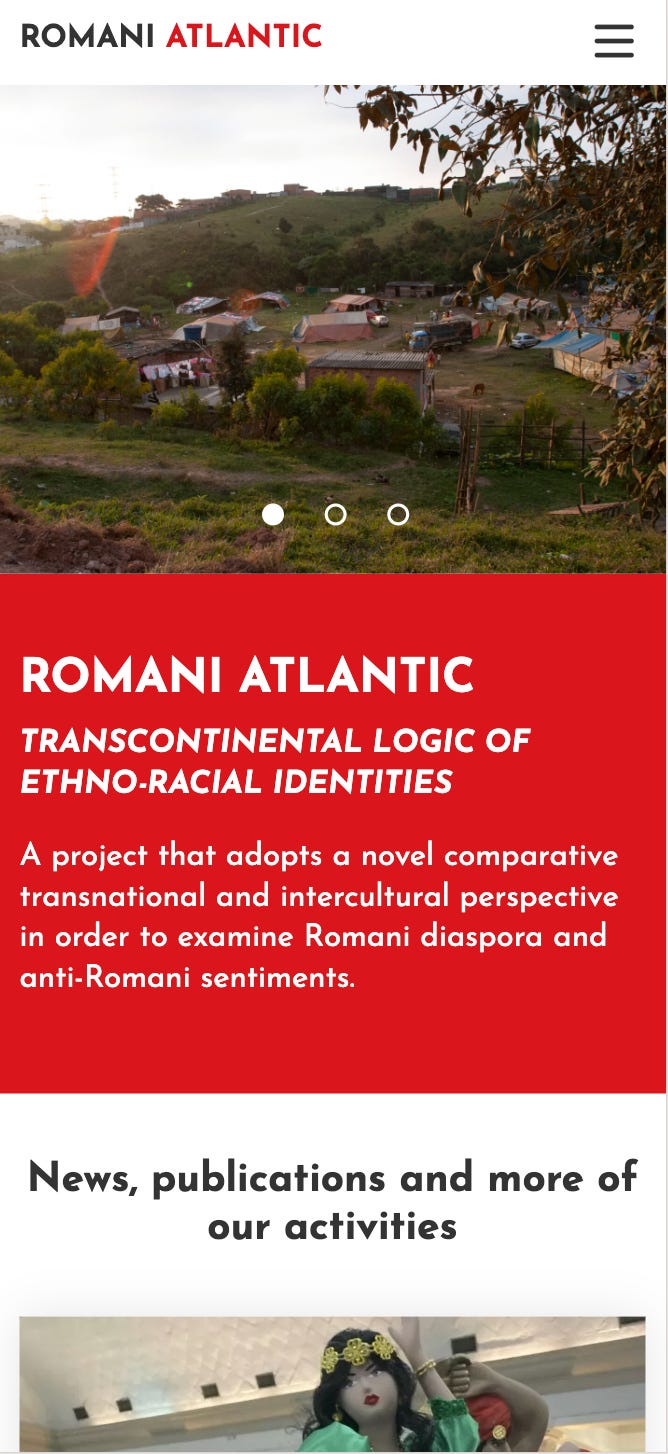
We see this extraction in its purest, most clinical form on the digital interface of the Romani Atlantic Project. The project explicitly boasts a mission to step away from “methodologically Eurocentric” models, claiming it wants to focus heavily on the “Lusophone Atlantic contact zone” and conduct extensive ethnographic research in Brazil. [1, 2, 3]
Yet, if you look at the actual financial and administrative architecture of the project, the deception is jaw-dropping.
First, look at the visual representation they chose for their front page. To represent the vast, complex, multi-century history of a global diaspora, they splashed a stark, boilerplate image of raw poverty myself and my community know all too well—reducing a vibrant, living culture to a comfortable, voyeuristic gadje trope of misery that provides no agency for the residents of this community. This is a Lusophone contact zone for whom?
Second, look at the roster of paid institutional collaborators—the primary investigators and salaried researchers who actually secured the foundational European grant funding. They are an all gadje (non-Roma) team. Five out of six are white Europeans. The foundational wealth, institutional security and professional prestige of this project was built from the ground up by and for gadje academics.
When pressed on representation, institutional gatekeepers will inevitably point to the table of contents of the forthcoming Cambridge book to show a chapter authored by Romani scholars to claim the project is inclusive. But this is precisely how contemporary colonization operates: the foundational institutional wealth, long-term governance and structural funding are reserved exclusively for gadje architects, while working Romani contributors are brought in at the end to populate chapters or sit on advisory boards—typically with no or little pay.
I myself had this opportunity for participation and withdrew due to ethical concerns, my PhD, my career and the fight to protect my housing and heritage at the corner of Gay and Christopher Streets in NYC. Still, I submitted previously unknown locations of importance to my community for a UNESCO heritage project, and the only thing I heard back was from another researcher who told me what I submitted was interesting, before providing no further information. This provides the tokenized diversity metrics required to legitimize the text, while the foundational administrative machine remains entirely monopolized by elite gadje networks.
They exploit our narratives to fulfill their grant requirements, while shutting out local North, Central and South American Roma and some non-Roma scholars of color from foundational institutional funding, refusing to hire local Brazilian academics to co-lead the core research infrastructure, and taking the literal maps from the walls of displaced independent researchers to design their book covers.
But this is how major institutions operate. Earlier this year, a major Midwestern university hosted a conference focusing on the links between African-Americans and Eastern and Southeastern European Roma. I wrote to the organizer, pointing out the profound irony of hosting this event in Ohio, a state home to deep roots of American Roma who currently possess zero legal recognition or civil rights protections and have lived this struggle alongside African-Americans.
The response from the organizer—who, columns of irony aside, endorsed the very Romani Atlantic book that features the map from my displaced home—was telling. She admitted she didn’t know anything about that because it wasn’t her expertise, before offering the standard institutional pivot: inviting me to submit a paper.
She values the abstract, trendy connection between Black and European Roma because it fits a comfortable academic syllabus, but she completely ignores the literal, living American Romani scholar standing right in front of her from Ohio. Meanwhile real Afro-Romani lives and stories remain buried.
We do not need to make our struggles legible in activist and academic circles before we desire rights, protections and space to tell our own stories and preserve our own culture. We do not need to appropriate African-American race discourse or European Romani frameworks to know who we are—although I always welcome discourse that is genuinely collaborative and non-extractive. The “Atlantic world” framing has always been a problematic appropriation or outgrowth of Paul Gilroy’s seismic text, The Black Atlantic: Modernity and Double Consciousness (1993). Here it turns into a form of gadje fracking into our culture that erases and supplants our own native methods of navigating the Atlantic world for five centuries—many of which are found in dance.
I would not have made it through my life, and neither would my family, had it not been for Black, Indigenous and African Americans who have stood by our side and gave us guidance and assistance. And we have shared so much in return, from solidarity in the Cleveland and East Cleveland Public School system, in dance and culture and in navigating the toxic American healthcare system. American Roma are not immune to society’s ills, including racism, and neither are Black and Indigenous people immune from absorbing some gadje anti-Gypsyism. But we navigate our struggles all the same, often together or separate in solidarity.
The discourse has been extractive. Gadje senior scholars who do not know our struggles, and who risk nothing of their own safety or housing, were always rigged to finish ahead in this academic race. They come talk to us, and then go inside and lock the doors of elite spaces behind them, leaving us outside. Perhaps the saddest part for me is that I was warned by elders inside and outside my family, and yet I had hope that real change was coming. The only change that has happened is that Gypsy Lore S tudies is now, officially, operating under the name of Romani Studies—and this time, claiming authenticity and representation.
There have always been Roma collaborators who are exploited, and if we are to have a decolonial academy, this practice must stop. We must be the funded, institutionally anchored authors of our own history, lives and destiny.
Those of us who have been here, who have survived generations of horrors, remain silenced—our living spaces emptied out, and our maps placed on the covers of books we are excluded from writing.
While I have been facing my case, which is still languishing in the New York State Supreme Court after the higher Appellate Division ordered this court to hear the case after rejecting it—as documented in the New York Courts Appellate Division Order (August 2025)—my struggles are turning into a touchstone in the history of housing rights and corruption in New York City. Meanwhile, fellow senior Romani activist and attorney Lorcan Otway and his wife had their home and historic theater—which was home to the historic Negro Ensemble Company—stolen by what many are now calling deed theft, which is spreading across the city.
I know the deep institutional resentment is there because we dare to exist outside of their neat, theoretical boxes. They want us as passive artifacts of the past, not as living, credentialed intellectuals demanding our rights in the present. They may hold the keys to the university presses, and they may have taken the map from my wall, but they cannot extract the truth of who we are.
What Has Been Stolen From You
Thank you, Traveler, for sitting with me as I talk of monsters, memory and ocean worlds. I ask you to listen just a little bit more, because this part is not just about me or the diverse, enormous web of my people. It’s about you. It’s about all the times a gadjo has joined me by the fire, and why I sit by your fires of hearth, art and knowledge as well. It’s about all the times the non-Roma have looked to me for something that they believe I have that they do not. And it is exactly this that is being stolen from you.
Maybe at this point, you are skeptical that there is in fact an issue here. Or perhaps you agree with me, but like so many before, you think, “This is just how it is.” They are powerful, and, clearly, I am not. These things happen, and perhaps it doesn’t mean it is all quite so bad. But just ask this question of yourself before you walk away: “Why does all this matter to me?”
It’s an important question because, in truth, I think most Roma do not need or want an Oxford Handbook of Romani History, nor do we need an “Atlantic” academic cosmology imposed upon what we live every day and what our culture handles naturally. Our memories are long, and as I argue in my research, memory is the basis of not only our culture, but of liberation in movement—in time, space and intention beyond colonialism and its many occupations of our lives. And this, although perhaps a precious thought, is why this matters to you, and why this research has so mysteriously been suppressed. Just think about it.
To give perspective on the scale of the silencing and mediocre-at-best scholarship, consider this: our presence within Europe, Africa and the Americas is as old as—if not substantially older than—every single modern nation formed within them. Imagine if the tables were turned. Imagine if we applied the exact same reductionist, pathologizing criteria that the Oxford and Cambridge University Presses of the world throw at us, and used them to rewrite the histories of the world.
Imagine if we published peer-reviewed volumes declaring these absolute, immutable historical “truths” about their elite cultures—the exact types of statements that are said, both overtly and tacitly, about ours in every single publication without a second thought:
On the English Language: “The English dialect cannot be classified as a distinct linguistic system; it is merely an un-codified, hybrid patois synthesized from fragmented low-Germanic vernaculars, fractured Norman French, and appropriated Latin roots. It emerged late, lacking the structural purity and historical depth of ancient, foundational languages.” [1, 2, 3]
On Anglo-American Economic Development: “The Anglo-American economy demonstrates a fundamental incapacity for organic, self-sustaining stability. Its structural survival relies entirely on a continuous, pathological cycle of crisis and territorial enclosure, extracting wealth through the systemic looting of global indigenous labor and sovereign foreign resources.”
On Czech National Legitimacy: “The historical narratives produced within the Czech lands lack foundational authority, and their claims to deep cultural sovereignty must be viewed with skepticism. Methodologically speaking, the independent nation-state is a modern, highly unstable administrative invention, established only a mere three decades ago in 1993.”
On French Cultural Patrimony: “French civilization possesses no authentic, indigenous aesthetic lineage. Its legal frameworks, high arts and musical traditions do not reflect an internal evolution, but are instead a collection of stolen cultural artifacts, forcibly extracted from the sovereign populations they colonized and enslaved across the Atlantic world.”
On German Post-War Modernity: “The German socio-economic model is inherently fragile and historically volatile, masked by a superficial illusion of modern stability. Scholars must bypass their current middle-class assertions and freeze the culture permanently within the pathology of its mid-century abject ruins—utilizing the structural scars of the genocides they committed to secure external humanitarian and research funding, while systematically barring their surviving intellectuals from governing their own narrative.”
On Scandinavian Cultural Authenticity: “The claims to historical and cultural continuity within the Scandinavian lands must be entirely dismissed as illegitimate. Because their contemporary populations drive modern vehicles rather than Viking longships, and because their lineages have integrated with outside linguistic and genetic influences over a millennium, they fail the fundamental metrics of historical purity. They are merely modern impostors playing dress-up, entirely unqualified to govern or speak on their own ancestral heritage.”
This kind of thinking is not only dehumanizing and evil, it represents a profound, hasty misinterpretation of not only our culture and what’s at stake, but of how the world actually works—and how deeply all human beings love and share culture, regardless of their material conditions.
But imagine a millennium of that structural silence. And then imagine that after a thousand years of being locked outside, an elite press finally allows two individual authors from your community to speak a few words in a single chapter—without ever dismantling, questioning or erasing the massive mountain of colonial academic garbage printed before them.
Suddenly, those two lone individuals are handed the impossible, crushing responsibility of “representation.” They are forced to act as the tokenized shield for a multi-million-dollar gadje project, while the foundational administrative power, the salaried chairs and the framing of the narrative remain completely unchanged.
On narrow academic terms, their well-funded work may claim a sterile salience. But the framing is fundamentally broken. Roma and Sinti do not struggle with the language and barriers of empire in the same way gadje do. These texts, should they continue with the same funded, prestigious looting with which they were carried out, will continue to be a plague onto us. It is better they not be printed and the information not shared, than to leave us vulnerable, commodified and fundamentally misunderstood—and our message of global humanity buried.
No, the reason this letter matters is not just because of what was done to me, or to Roma and Sinti scholars all over the world fighting for a scrap at the institutional table. Pity costs nothing. It’s because our very existence is living proof and memory of a world that does not need its borders, its defenses or its extractive academic empires to remember its own humanity.
We do not know if the world can ever truly rid itself of its vampires or its empires, but we know this: we have survived them for millennia, and we will survive them still.
Lacho dives,
Russell