

Looking for the Disappeared in the Dance of Fetters
How rhythm remembers the taken

In the annals of agony, most fall silently.
As we finished the last of the white wine after Sinead’s friend up from Kerry went to bed, it happened again. The moon touched houses lightly and lay across recently cut fields while I sunk again to the place of forgetting, and Sinead remembered everything. When understanding man-made misery, it helps to be there. I knew this from years working in US American tech publishing, where the loss of Twitter and the wholesale billionaire buy of the press spelled the invisible death of investigative journalism—and with it, all its promise of public demands for answers. We were not sending people to be there anymore before they tell us what happened. Increasingly, the stories of some are never told.
Sinead knew there-ness from being a human rights attorney. At the moment we were passing through Stormont, home of the Government of Northern Ireland in the ‘90s. Bodies are still missing from the Troubles. We had just left the collapsing buildings of Gay and Christopher Streets in New York City—a place where, for seven years, I navigated a hostile system of institutional neglect, housing corruption and the exhausting, everyday erasure that Romani people face when trying to protect their community’s intellectual history. In that silence, you remember what it means to be told that what is happening to you is not happening.
Now all over the city people who have fled horrors for refuge disappear off the street. Sinead’s father’s doctor was taken too. Pol Pot and his fear of people with glasses came next. We trade notes on humanity’s collective suffering, tracing time threads for the secret that would stop the weaving of cruelty.
As twenty people today are crushed in Gaza as they seek food and the US military supports genocide, I see fantasy. I have continually been an activist, but this approach falters. Was capitalism really welcoming us in, or just giving us a late start in a race already won?
Yet, there is survival in rhythm. I was carried across the dance floor in the sway and shuffle of my father’s waltzing steps. My mother taught me to rise and grind across the kitchen floor. This knowledge carried my family through a deeply segregated America, where dark and brown-skinned family members have traveled our roads with hyper-vigilance in order to survive. It pulled us up through the sharp edges of anti-Gypsyism, gave me the courage to outrun homophobic violence and ultimately fueled my escape from a system that never cared about my safety—only what it could extract from me. I can rise, and if I stomp loud enough, I can be heard.
This macabre speech continues through the night and follows me through herb-walk chats, across my whiskey rocks in an Irish trad session in Ennistymon and now across computer screen of precious metals most likely harvested with forced labor. We trade notes on dangers never far away. What would happen if we all stopped just to listen?
Maria screams with the sea. Artists have long represented exile and transportation; dancers simply hear it. When the empires of the sixteenth to early nineteenth centuries ran the Transatlantic slave trade, the archives show that prisoners cramped in the hold—sometimes for months—were forced onto the deck to dance. The profound cruelty was that this movement was never intended for their well-being, but to keep captives fit enough to maintain their value in slave markets such as the one found at the end of Wall Street on the East River in Manhattan.
The empire repeated this choreography on another voyage of bondage. As the British state sought to colonize Australia, it weaponized starvation at home in Ireland and Britain, forcing fathers, mothers, sisters and brothers to steal just to survive. Once arrested for these “petty crimes,” their punishment was transportation halfway around the world to serve as convict labor for aristocrats and merchants. On these transport ships—which carried white, Romani and Traveller captives alike—the baseline technology of the deck remained the same: prisoners were held in fetters, and ship surgeons suggested they dance to preserve their health. There is so much we do not know about what was lost on those waves, but we know the dance was coerced.
The long history of colonial enforcement with its perpetual systems of racism, patriarchy and bodily coercion for profit points to a forsaken lineage: the presence of punishment inside the dance. This was the violent taming of the many-headed hydra of commoners, sailors and the enslaved in revolt. This is how the state disappears a soul.
Back at the conference with Annette, a senior scholar laughed as he dismissed my work: “What does all this really mean? Can’t we just have fun dancing?”
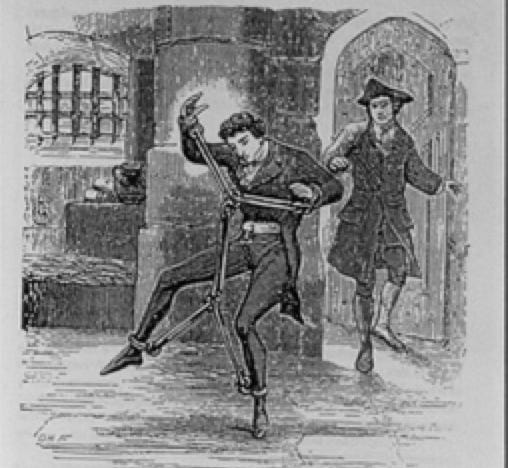
I recall an almost endearing theatrical woodcut of a man dancing a hornpipe in fetters after his arrest, and I see the scholar’s question for what it really is: a refusal to see how the empire turns the suffering of others into a commodity. This experience of oppression, felt so acutely and chronically by the marginalized, remains entirely invisible to those privileged by colonialism. They see a spectacle; they do not see how the chains have changed our shared reality.
They would have looked at Master Juba the same way. When Charles Dickens visited New York City and recorded his American Notes, he watched William Henry Lane—the founder of American Tap Dance:
Single shuffle, double shuffle, cut and cross-cut; snapping his fingers, rolling his eyes, turning in his knees, presenting the backs of his legs in front, spinning about on his toes and heels like nothing but the man’s fingers on the tambourine; dancing with two left legs, two right legs, two wooden legs, two wire legs, two spring legs—all sorts of legs and no legs—what is this to him? And in what walk of life, or dance of life, does man ever get such stimulating applause as thunders about him, when, having danced his partner off her feet, and himself too, he finishes by leaping gloriously on the bar-counter, and calling for something to drink, with the chuckle of a million of counterfeit Jim Crows, in one inimitable sound!
— American Notes for General Circulation. Charles Dickens, 1842.
Most scholars and practitioners alike delight in this whimsical, racist representation of a genius who broke through brutal systems designed to suppress him. He went on to bring his performance to Britain and Ireland, where his last presence was recorded in 1851.
Since I first read this text in 2014, it has struck me as grotesque: at best the writings of someone trying to cash in on what he did not understand. To Dickens, Lane’s dance was whirling, dazzling nonsense. For those who carry lineages of impact—of violence—we know what we are listening to, and what we are moving beyond. And while Dickens would live on in comfort and dominate the archive, Lane simply disappeared from the public written record.
But the dance record, if you listen carefully enough, is different.
When I first wrote this piece a year ago, I had known for years in my bones that fetters dancing was important. I did not know why, but I could feel history rhyme in what we call tradition. To dance with impact is an invitation to autonomy of time, space and energy—of what it is to be you, right now, regardless of the bondages imposed upon you. As I tap upon my body, tables and the world as I navigate my own displacement and precarity, these familial rhythms prepared me to re-orient to here. But where did they come from?
In my ongoing work to recover the fullness of my culture and understand kumpanija, I began a renewed search into fetters dancing and found the work of contemporary Australian researchers looking into the colonial history of convict dancing. Their work felt like I had found a gigantic piece of the puzzle, but I was not prepared for what came next.
As I have gotten to know the work of Frances Roberts Reilly on Substack, she shared with me a piece of her family’s past recently recovered:
William Wood the Younger... was described as a fiddler and coachman... standing 5’6” with a kauli mortsi—swarthy complexion, black hair and hazel eyes. In his bloodline, he carried our family’s Gypsy music talents. Australian contemporary Colonial Dance researchers have found that ‘on route to the colony, the surgeons in charge of convicts often encouraged dancing as a healthy activity and this is documented in their medical journals.’ So it’s likely that William took with him our Romany Gypsy hornpipe and jig music...
Here’s an account from Rom Moses Heron describing how wrenching it was for sweethearts and families to be separated. Moses took out his knife and cut his diklo—handkerchief from his neck and threw it overboard for them to take the knot back to his sweetheart. He had cut the diklo from under his ear so that the knot was undisturbed but remained just as he had tied it.
Here, right before me, was proof that the dance was telling me more about Romani history than what could be found in any academic book. It’s not just the feeling of confirming they were there and what they went through that brings a meaning like no other to do the dance, its the reality that our intuition—our powers to understand the many occupations of the world and how to resist them—is perhaps them looking for us, just as much as our own memory looking for the truth. Our ancestors are trying to find us.
Maybe in our batters, shuffles and rallies we keep the sounds going. Maybe the rattles never stopped. Maybe as we lose more loved ones to an abyss created by the greed of the few and the complicity of the many, we can keep their memory going in motion for all to hear.
This requires a deep state of listening to the state’s cold annals of agony while performing the living repertoire of the risen. We will undoubtedly keep trying to speak and write for the fallen, just as we stand to bear witness. Something else happens, however, in between the beats of slaps, claps, taps and stomps: we find moments of listening to the hearts of the taken, and the drumming of the risen on the ground. Those who have fallen, those who survived the annals—they are looking for us too. They are there.
It is a medicine carried by Roma and Sinti for thousands of years—and we will it carry for thousands more even as the empires of the world find new, horrific and silent methods of disappearing our bodies forever. It is a medicine I practice for my precious friends and mentors who disappear in the cracks of the inhuman systems we perpetuate. It is a medicine I see echo out into other groups confronting different faces of the same monster that wishes to dehumanize us so we can be exploited, or perhaps worse still, be another weapon in the machine. To dance in the face of such hopelessness is a miracle of humanity felt throughout time: an establishment of record that is in fact not so easily erased and can never be burned.
Back outside under the stars, Sinead and I continue our conversations as we trade notes on humanity’s weaving, the baskets that have carried innovations of kindness through fire, pillaging and plague. We will not know if it is suffering or kindness that we have woven until we look into the eyes of those left carrying the burden down the road. We will not know the weight of what we have carried until we catch them—or let them fall.