


In Micro-Dance 1, we slapped a reminder that we are here right now with our hands to our chest. Hands hitting our heart area sent immediate tactile and proprioceptive signals to our fascia and nervous system, prompting a shift away from habitual stress responses to tune into the present moment. Amidst the loud and demanding pulses, cadences, and schedules of the world, we established our own biological rhythm and said, “I am here.”
Now, we’re going to “snap out of it” and meet the world where it is through finger snapping. Your hands map to a disproportionately large area of the primary somatosensory and motor cortices (as famously depicted by the cortical homunculus) and are nourished by the ancient language.
Now, we’re going to “snap out of it” and meet the world where it is with an ancient language of the hands, which actually occupy the largest portion of your brain.
Micro-Clapping & Fascial Resonance
This second lesson shifts us from grounding inward to sonically reading and playing with the space around us. Chest-tapping placed us with lower bass notes inside ourselves; finger-snapping uses the massive density of nerve endings in our hands to create higher pitches that build immediate awareness of what is around us.
In percussive dance traditions, finger-snapping, hand-clapping, and castanets are not decorative flourishes. They carry ancient Romani knowledge of how to aid the entire body in times of change, crisis, joy and play. Finger snaps are famously celebrated by Flamencos, but they run through many of our impact-driven dance traditions—including those around the region now known as Hungary, where my people lived for generations.
When you snap your fingers, you produce a sharp, high-frequency kinetic impact. The acoustic “pop” is not actually produced between the thumb and fingers when they slide past each other—that friction is just building the tension. The snapping sound occurs when the finger rapidly strikes the flesh at the base of the thumb (the thenar eminence), creating a sudden air-compression impact. You can read more about impact-driven dance in my PhD dissertation.
Your palm and fingertips are packed with a massive concentration of Pacinian corpuscles: specialized mechanoreceptors built specifically to detect sudden changes in vibration and high-frequency shockwaves. These corpuscles live directly inside the fascial sheets and align precisely with the meridians running up your arms.
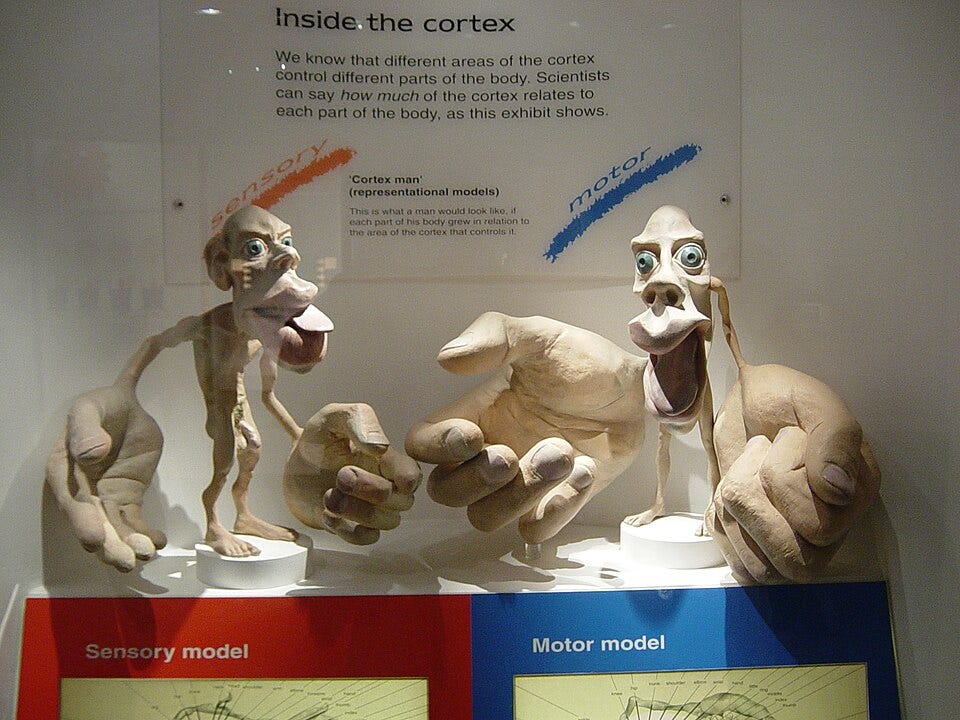
Because your hands occupy such a massive portion of your brain’s sensory map, finger-snapping acts as a targeted, localized neural stimulator. If you look at the homunculus sculpture, the enormous size of the hands demonstrates just how much of our brain's real estate is tied to them.
The rapid compression of the fingers fires off an instant cascade of electrical signals up through the peripheral nerves, bridging directly into the central nervous system. Simultaneously, snapping creates a micro-clap—a sharp acoustic attack that activates our evolutionary survival mechanisms. Just as high-pitched bird alarms or snapping twigs instantly wake us up in times of crisis, this crisp, sudden sound jolts the brain into a state of heightened focus and immediate spatial awareness.
When hyper-vigilance or anxiety makes us freeze, our peripheral vision and spatial awareness contract. Snapping outside your standard visual field—above your head, beside your ears, behind your back—awakens those deep receptors, lifts your energy, and signals to your nervous system: I have more information to help you process this space.
From “I Am Here” to “Everything Is Happening”
In trauma-informed work and somatic processing, we often try to resist, suppress or escape environmental chaos. We brace against noise, news, notifications and the stale energy filling the room.
The mantra for this micro-dance shifts expands our orientation from ourselves to a radical acceptance in the circumstances that we are in and most likely have little control over. And unlike loud hand-to-hand clapping, you can do it all discreetly with almost no one noticing.