


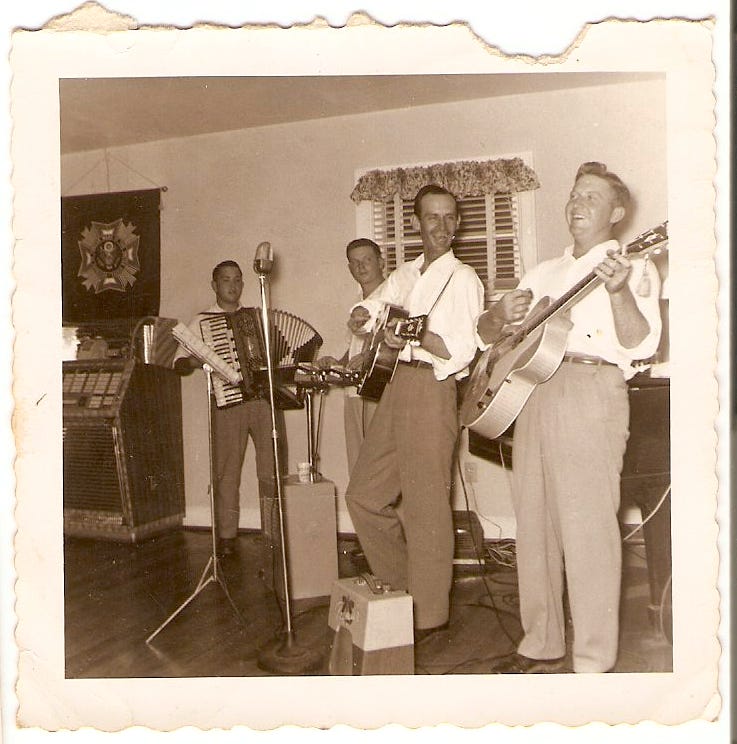
It is never too late to dance with your father while listening to the songs of your mother.
Who is allowed to fall? What is the repertoire of the risen? What secrets are hidden in the silent, violent archive? What vampires guard their vaults, and when we meet them, will we know the truth?
What, then, is the courage of the dancer, and what is the dance?
For the last year, I have been returning to these questions in writing and in rhythm, and I invite you to do the same. As this project has moved from our community in Ennistymon, County Clare, to Spain—with my family, my digital mahala, and alongside activists and resistance movements around the world—my answer to what my dance is (and what I can teach others) has become crystal clear.
Now is always a good time to sway to a lullaby, have your toes and fingers counted in song and bounce across the ballroom floor in the arms of someone who is half your whole world. If you bear with me on this, you have permission to do it—even if it never happened for you as a child. In fact, we need you to do it. And then keep doing it through time.
When I first heard academic circles speak of decolonization, I wasn’t sure if I was listening to theory or practice. That is: are we actually going to do something about this, or are we just talking about it? If things were taken that shouldn’t have been, who is accountable to give them back, and to whom? As so many are observing online, what does any of this mean when the colonization never actually stopped?
I doubt the ability of the academy and most NGOs to do anything other than use “decolonization” as just another tool for colonization. Like many children in marginalized families, my parents helped me understand from an early age that things were deeply wrong in our society. They taught us that we need to hold onto our humanity because no one is coming to save us. It seemed to me that the only thing any of us can truly do is hold ourselves accountable—and, if possible, hold each other together.
When I began my PhD in a small, rebellious program in Ireland, I received confirmation of this. While I may not be able to stop colonization as a whole, I can rigorously examine my own life within it with humility. I can see what’s really there once the accounting is done. I can let myself be stripped bare to the beams and rafters, and then dance. I can study the choreography of our civilization to see which traditions I will, in sober truth, carry forward—and notice the impact they have upon others.
This has led me to one truth I can stand by: the power of dance as a decolonial method. In my research, the ancestors in the archive brought me repeatedly to the reality of how Roma, Sinti and other oppressed peoples were subjected to bondage of all sorts—including being transported in fetters or wearing heavy wooden shoes at gunpoint to perform hard labor. Yet, even in these horrific conditions, dance allowed a reclamation of body, time and space. As I wrote in my PhD:
Our percussive dance tradition is a creation like no other. Even if we lose it all tomorrow through some disaster or unfathomable new evil form of body control, someone would find the rhythm of life in their body again. They would tap on the futuristic cage around them, and no matter how many times they were stopped—the pulse would spread. Gestures are contagious. Rhythm propagates. When we are down or when we are gone, the weights we carried in our dance now carry us.
I would go even further now. I have learned in this last year that impact-driven dance isn’t just decolonial or pre-colonial. It continues in a world where colonialism simply does not exist.
Body rhythm is the world where my father woke me up every morning playing the tin whistle and carried me around the ballroom floor; where my mother taught me to walk around the house on the balls of my feet, just as dancing masters had centuries ago; where my grandfather sat in the kitchen playing his accordion for anyone entering, while my grandmother sang, painted and sculpted.
This was always my land. It will only be colonized if I let it be taken away—or if I turn into an occupier myself, standing in traditions and timelines that are not mine to move through.
The liberation so many of us are seeking is, if we are honest, so often a longing for that innocence of connection to our parents—that increasingly forgotten world of play in music, dance, nature and community. We can bury this longing and pretend it isn’t there, or we can finally be hospitable to it, let it in and give it a cup of tea.
If you give this a chance, even for a moment, I think you’ll find that the longing is the evidence. The play of life was always there, waiting for you to accept it. Regardless of your relationship with your parents, your desire for this intimacy—for the truth of your body in dance—is proof that it has always existed in your ancestry, your lineage and your blood. All it needed was for you to start tapping, quite literally, into it.
I created Gypsy Fires because I want to share my researched path through Romanipen, so that I might help you see what was never taken away from you. I aim to do this through these letters, inside the Timedancing Lab where I teach embodied liberation theories, and through micro-dances designed to help you make movement the primary method of your life.
The courage of the dancer, then, is to keep dancing. What that dance will be, where it came from and where it is going—that is something only you will find, and we are all discovering it anew in every moment. Whether this choreography will decolonize our destiny or perpetuate harm is entirely up to us.
We have the moves. We have the heart. We have the dance.