


Welcome back to Gypsy Fires. This letter is about dance and why it knows more about AI than Stanford or MIT.
Dear Traveler,
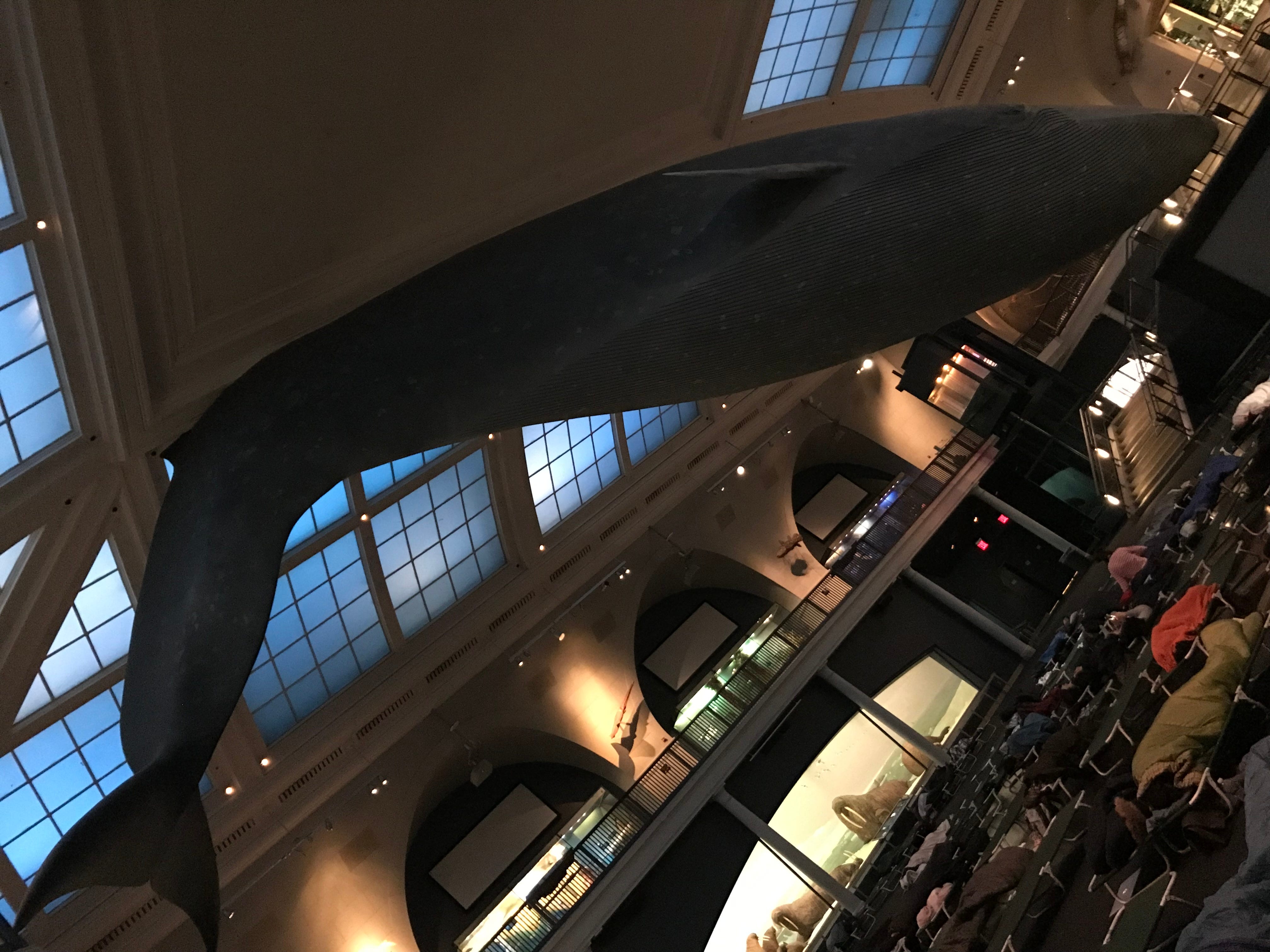
Meet me tonight under the Blue Whale. There we will turn in to rest after we danced around the world—spinning through the seas, swaying over ice with the Arctic muskox, flying through the African Savannah and exploding through the cosmos. We will build machines to keep our ideas moving, and maybe you’ll join my kumpania1 as we train our own robots to predict the storms of Jupiter. We will sleep under a sea monster and dream together of a future where technology does not help extract from nature, but helps us understand it and live as part of it.
The year is 2019, and we are joining data scientists, software engineers, product designers and NASA scientists organized into teams for a weekend in the American Natural History Museum in New York City. Outside we can all feel the fabric of the world as we know it being steadily pulled apart, but together we are stitching creative ambition together so that we can better understand our solar system—our tribe of planets hovering around a star. On my team, we’re using the patient power of statistics to train a machine on how to read NASA’s pictures of the storms of Jupiter so that we might be able to ask how they form and why.
By the morning and after many bags of potato chips, cups of coffee and cavorting through the empty halls of the museum alone, our baby “AI” is able to make small predictions on what a Jovian tempest will do next. Through open source technology—the unpaid backbone of computer technology and internet crafted and cared for by gentle, brilliant souls—and collaborations with space scientists and the patented algorithms of other highly intelligent hardworking people, we worked together alongside other teams to show how computers can do more than make people money. They can solve a few of the most ancient questions we’ve been able to find as a species.
Now it is 2026, and this egalitarian vision of Machine Learning, what people are now calling Artificial Intelligence, has gone missing. Someone took it away in the middle of night while we were sleeping around our fires, and we are now awaking to a forest that has disappeared. An ocean turned to acid. Our young mothers and fathers told to go home because there is no work today, and they are told there never will be work or payment for it again. Some do not even make it home, and in an increasing number of cases we don’t know what happened to them. In the distance we see a massive building spewing smoke into the air and hear the steady roar of machines set to work on tasks that no one seems able to make any sense of.
The world watches afraid. I watch, afraid. What is happening on the roads that hold the world together? On the roads of my birth home, Turtle Island?2 Are people fleeing? Enjoying a luxury vacation? Will we meet animals on the road, or are they gone too?
The world is awake to what Artificial Intelligence might be and awash in interpretations of what it means for us. As I pass by conversations on my route, I notice most people can’t even agree on what intelligence even is and whether it can ever be artificial. If human intelligence can in fact be manufactured, do we want that? If it is only somewhat able to be reproduced robotically, is that useful? At what cost? A constellation of problems erupts that is not failure of the computer, but the failure of our global (especially US American) leadership to understand how the machine of the world runs at all.
If we turn to the university, where I decided to try my chances in hopes of finding like-minded people beyond my verda, there is only one department that’s always already been prepared to face the existential questions of a potential age of AI. It’s probably near to if not the least funded. It’s not easy to find, it’s rarely required and is certainly the least respected. It’s dance.
Yes I am saying that there is a department in the university that has vastly more experience than Stanford or MIT’s AI labs in asking existential questions about us, and that’s because it’s the only discipline where you can’t pretend to take people out of it. While we keep pumping billions into elaborately asking what a universe would be like without us, dance has always kept us in research, in practice, in theory, in the archives, in the classroom, in the world and in life.
We have Diana Taylor who has been telling us for over two decades that what we record doesn’t always align well with what we remembered to keep doing. We have Thomas DeFrantz telling us that we can refuse the call to do work we shouldn’t be asked to do in the first place, but we don’t have to be lost either. We can dance right now, together. We have Jacqueline Shea Murphy telling us that we need to listen to indigenous people, not just because it’s the right thing to do but because there is so much wisdom there asking us to stop fighting it. We have Lynn Brooks, Julie Malnig and Linda Tomko who have shown us that dance has always been a science of aspiring to our best selves, and continuing to play anyway when it doesn’t work out.
We have Judith Butler’s gender as a performance, which if we return to Vogue/Ballroom House we learn that we were meant to have fun with gender too. We have Sarah Whatley asking what are the choreographies of laws, and how do those of us who don’t fit within those laws move at all? We have André Lepecki asking how we can understand the political and police as choreographers of liberation and control, and how they propagate in themselves a dance.
We have Nadine George-Graves asking why we have a history of consuming Black bodies, and how do people of color move through such a landscape with such terrors hidden within it? Báyò Akómoláfé asks us to embody what it means to build a society today from our traditions. We have Breandán de Gallaí asking what does it mean to move with your native language, especially when so few around you speak it. And there is my friend and colleague in Romani Dance Studies, Rosamaria Kostic Cisneros, asking so courageously within communities: what is it to be hero for your own people? There are thousands of people who devoted their lives to helping you not just ask who you are, but excited for you to move through the question and discover the answer in motion.
You now also have me, your neighborhood internet Gypsy, inviting you to query what is intelligence itself? If we listen to the physicists, those dance scholars of the forces of the earth, sea and sky, we can consider that we’re all made up of space, time and energy—and that these three things are inseparable. They are understood together. And notice, they didn’t say space, time and shareholder value. They didn’t say space, energy and laws or religions. Just these three simple things.
With this information let’s rewind our clock further back—and then much further back again—and try asking again what is intelligence. The building blocks of awareness—the consciousness that gives rise to intelligence—is motion itself. We don’t understand anything until we have changed position. Or we discovered after venturing forth or within. Collapsed and then got up again. What foundation of intelligence is crafted from the orbit of a star—a faithful returning? Did the first lifeforms come to be because they just are, or was it because they went looking for something? We can understand an American Bison because we can see it in a museum or dissected in a lab. But, as has been confirmed this year, Bison have meaning because of their knowledge: their massive herd migrations nourish their families and the landscape. We only need to let them roam again.
I stay on my road not just because I am stubborn. I stay not just because I know at the end of many gadje roads for some reason they keep putting meat grinders, as gilded and as comfortable as they may be. I stay on the road because it leads to more paths. The more I keep moving the more I understand why others moved before, and I can fortune-tell where people might go in the future. I know intimately that the magic in machines isn’t in how we make them look and feel like us, but in how they move and “think” in their own right. And that’s what allowed me to climb up into tech management in rare speed. I knew how to get there.
That night I slept under the whale, I made a decision to stay on the road of collaborative scientists, computer technologists and creatives working to solve the world’s problems. In the years that followed, COVID, aggressive tech monopolies and personal brands pulled people away from this modest, kind, exciting road and onto superhighways and private jets. Many were simply pushed off the road and into ditches. At seven years out, I know as a Gypsy and a dance scholar that now is about the time where people start forgetting that the other more open source, egalitarian possibilities for our technological future were ever there at all.
Tonight, camp under the whale with me. We have hopes to engineer together.
Lacho drom,
Russell


My traveling company.
For some indigenous people, Turtle Island is a name for the continent of North America.


