


In early 2023 I was working in engineering for America’s largest publisher, and I could see something was going very wrong with the publishing industry. For years billionaires had already consolidated ownership of almost all US American presses and news outlets, an obvious conflict of interest as journalists are supposed to expose bad dealings in business and politics. Now “Artificial Intelligence” was gaining mass popularity after a couple decades of floundering under the much less sexy name of “Data Science".
While my colleagues were excited, I went on our public AI enthusiast Slack channel and threw water on the party:
This is not AI, it’s just algorithmically brilliant machine learning, or glorified N+1 math
They’re using the term “AI” to hide that they are scraping all our content, training their models on it and then stealing our customers!
I had learned how to use Machine Learning years ago, and knew that the models themselves don’t know how to do anything other than predict—they’re worthless without content to train upon. While I received silence from my colleagues, months later the primary owner of our business, Barry Diller (famously the inspiration for “Mr Burns” in The Simpsons), sounded an alarm that publishing and print were in danger from copyright violation on a massive scale.
Now, Anthropic has been revealed in their secret Project Panama to be buying millions of books—especially old and rare—scanning them and then destroying them. Anthropic’s apparent ethical advantages over scandal-ridden OpenAI has not only collapsed, but revealed solidarity with OpenAI’s CEO Sam Altman’s desire to create “a future where intelligence is a utility.” Suddenly, the original open-source dream of AI and a world with more access to information becomes a dictator’s dream of paying for access to machine-curated information.
The destruction of the books after ingestion by bots has the internet particularly up in arms, and with good reason. This is an old playbook to enclose knowledge, put a price tag on it and destroy anything or anyone that isn’t in line with the propaganda. But the pattern goes much further back than people realize, and reveals the power of the alternative libraries of the body and how they resist and survive consumption.
The Machine Behind Gutenberg
When the story of the European Renaissance and Age of Discovery is told, Johannes Gutenberg’s invention of the movable type printing press in the mid-15th century is typically cited as a reason for the “Enlightenment” from the Medieval Dark Ages. But this myth hides a much older story of theft of technological innovation and the banking strategy that would be used to enclose this technology, enabling centuries of book burning, genocide and the suppression of human memory.
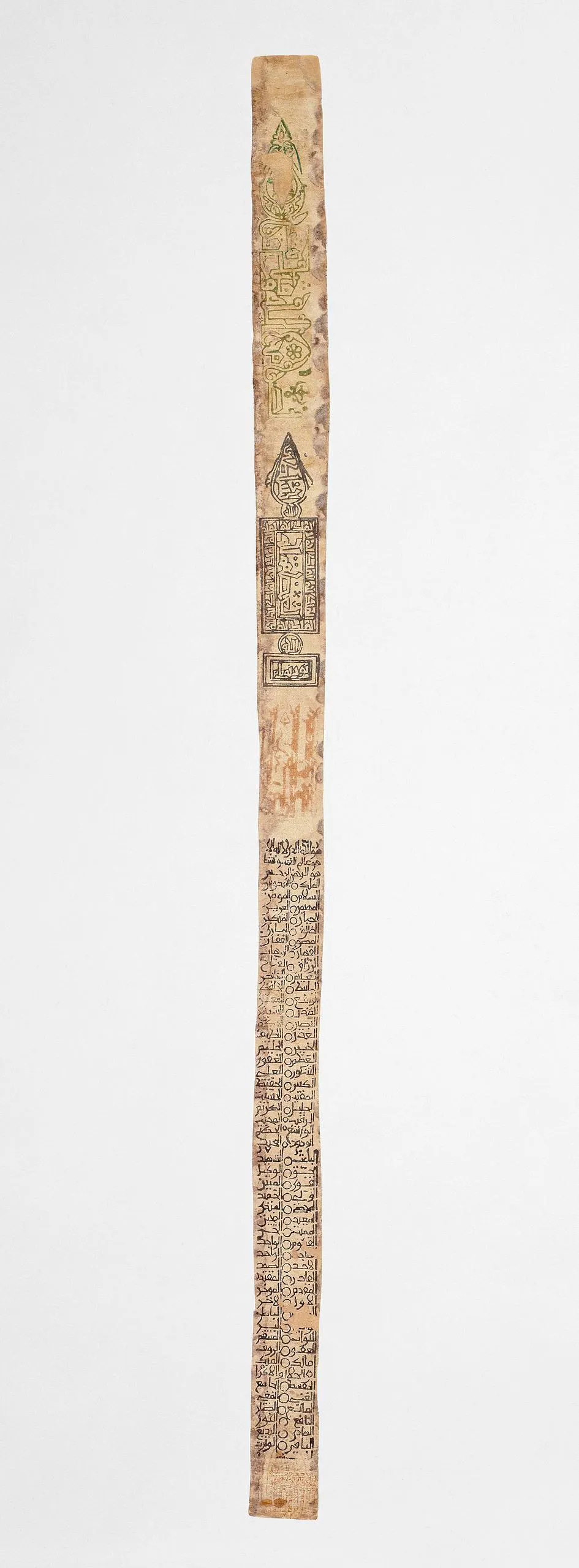
Kristina Richardson’s groundbreaking text on the Roma in the Medieval Islamic World confirms that the Roma had been using print since the 10th century. We had this technology thanks to our highly-valued work within Asia, and the technology had been developed earlier still in China. As Roma and Sinti crossed into Southern Germany in the early 1400s as “Gyp-sees” (from Little Egypt), German medieval monks came into contact with our block printing presses and the diverse religious texts we were printing with them. The deep irony, of course, is that the technology we helped pioneer would later be turned into an instrument of our own erasure.
Now is the second part of the history of print most people also do not know. To pull off his invention, Gutenberg took on enormous loans from Johann Fust, a wealthy goldsmith and financier. When the press was finally operational, Fust sued Gutenberg for debt repayment, foreclosed on the shop and seized control of the enterprise alongside Gutenberg’s foreman, Peter Schöffer. Fust used Gutenberg’s press and amassed a large fortune from scaling it up. One of his earliest and most profitable enterprises was the morally bankrupt process of mass-printing letters of indulgence (paid forgiveness of “sin”) for the Catholic Church.
When the elites saw the Roma and Sinti bring ingenuity, they saw not only profit but the possibility of control of all forms of knowledge. Gutenberg’s bible did not bring a new age of enlightenment of knowledge and democratic learning as we have been told, but one of global censorship and a transfer of knowledge and wealth. It created a centralized version of the bible so that other bibles and texts could be cast out and destroyed.
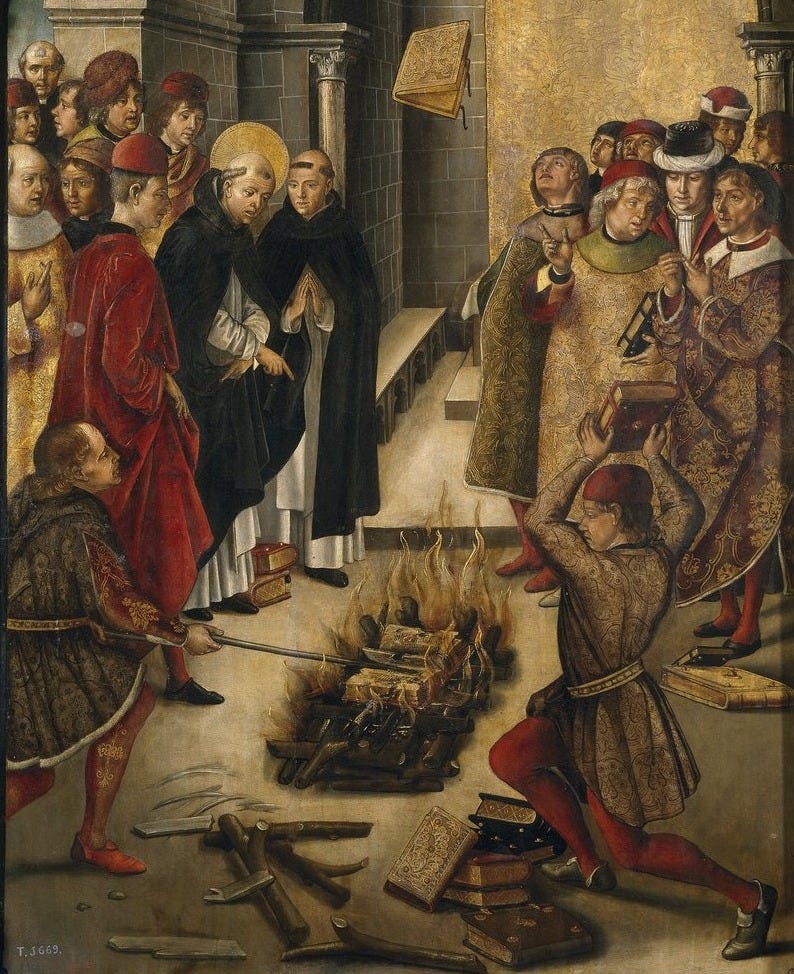
Pedro Berruguete’s 1490s painting of Saint Dominic was commissioned at the height of the Spanish Inquisition and visualizes this exact doctrine of erasure. “Heretical” books burn in a public bonfire while the approved text miraculously floats unharmed above the flames. In the eyes of the Church, fire cleansed the world of blasphemous texts leaving all competing knowledge and many of the people who carried it to ash.
This ideological violence was immediately scaled through banking’s support of the printing press. Texts like the Malleus Maleficarum (“The Hammer of Witches”) in 1497 were mass-produced, quickly becoming European bestsellers. The manual was weaponized across Europe and exported to the Americas to identify, torture, extract knowledge from and execute “witches.” Hand in hand with inquisitorial blacklists and imperial decrees, print technology systematically outlawed folk medicine, herbalism and indigenous codices worldwide.
As feminist scholar Silvia Federici observes, this was not mere religious fanaticism; it was the enclosure and colonization of embodied, female-led medicine, ecology and community health. Indigenous libraries around the world were looted and destroyed. Centuries of localized wisdom were forcibly stripped from autonomous practitioners and extracted into the institutional hands of aristocratic, ecclesiastical and mercantile men.
Gypsy Fires is independently funded and I am not institutionally affiliated. Your support is greatly appreciated and gives you access to more in-depth Romani philosophy in the Timedancing Lab and lessons in the Micro-Dance School.
The Eye of the Machine
This data-driven enclosure was not limited to medicine. The 1824 Ordnance Survey of Ireland—the most ambitious mapping program in history—demonstrated how cartography and print could be weaponized for imperial surveillance. But in the 19th century the obsession with observation turned to eugenics. By the 19th/20th century, British and American "Gypsy Lore" scholars were indexing Romani skulls, lives and lineages. In the 1930s the Nazi Racial Hygiene Research Center would take the colonization of our culture to an entirely new level.
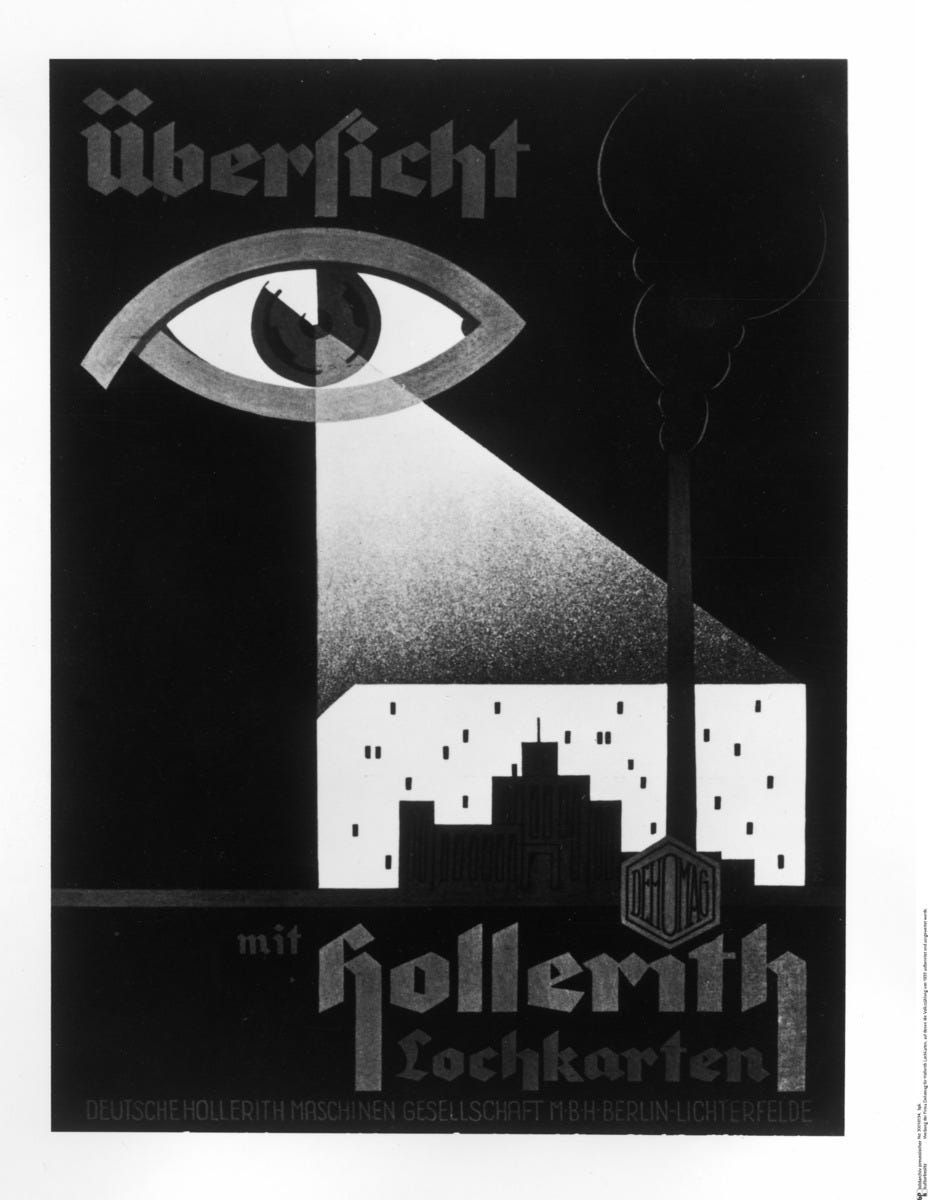
The Reich studied Roma and Sinti lineages, languages and social networks , and provided that data to IBM’s Hollerith punch cards. These cards were fundamental to the development of computing in the 20th century, and they were used by the Nazis to target, round up and kill at terrifying speed. They confirmed an ancient relationship between bankers who buy technology and despots looking for the power and financing for authoritarian rule.
Today AI companies like Microsoft partner with OpenAI and seduce us into digitizing Romani languages in the name of “inclusion”. Meanwhile, Meta’s smart surveillance glasses offer real-time translation tools that ICE agents can weaponize during deportation raids of innocent people who are disappeared. In the United States, Roma and Sinti remain legally unrecognized and unprotected, leaving communities vulnerable under legacy “gypsy laws” designed to criminalize and expel. We cannot even count the crisis as European Roma and gadje academics remain focused almost exclusively on Europe.
The Library of the Body
How does knowledge survive when the state indexes information and industrializes deletion? It lives where it has always lived: in the body. How does it protect itself? By staying unwritten.
When the Druids were invaded by the Romans, they continued to keep their most sacred teachings private and unwritten. They saw the machine for what it was—something coming for their resources and entire way of life. Their choice to withhold knowledge and resist led to the long-standing myth that they were barbaric and illiterate—a claim disproved by Julius Caesar himself, who recorded in his Commentarii de Bello Gallico (Book 6, Chapter 14) that the Druids could read and write for everyday matters.
Their rich oral culture did not prevent their stronghold on the Isle of Mona off the Welsh coast from being sacked, their sacred oak groves cut down and their lands torn up for copper. (Sound familiar?) Yet, it did protect their wisdom so that it could live on as embodied, lived knowledge that people still carry today.
This tension between written state records and unwritten survival lived directly in my own upbringing. When my mother was the first in our family to go to university, she wanted to study journalism. Along with my father, they read books at incredible speed, reading entire novels in a day. We had a computer in our house before almost all of my classmates, and we always believed in the power of what I call embodied engineering. This means to intuit and move with machines on their own terms and adapt their use in order to communicate through hostile terrain. A couple decades later I ended up doing just this: managing websites for America’s largest publishers.
We did not know the written history of our ancestral connection to print. It was our ingenuity that carried this knowledge—a lifelong practice of translating our somatic intelligence into something the world might understand. This allowed me as a software engineer to understand code as choreography and choreography as code and work in the complex world of online publishing for brands like the Fortune500 and People Magazine.
As I will repeatedly argue in Gypsy Fires and in my post on the practice of Timespinning, knowledge carried in our bodies can never be destroyed so long as the longing remains to remember it and the morals and values to answer the calling through. To put it simply, we remember more than we are told in books or by the state. Our nostalgia for pre-industrial harmony with nature and each other does more than yearn for what has been destroyed; it’s a book handed down to us from those who came before asking us to “read” what we were given when we were born.
What Lives On
Today, as blacklists re-emerge, western nations strip funding from arts and humanities departments, and corporate powers race to adopt generative AI, we are watching the censorship mechanisms of ancient Rome and early modern colonialism re-assert themselves in real time. Our uncritical adoption of AI doesn’t just automate labor, it feeds an extractive machine that threatens us professionally, socially and ecologically. It claims a monopoly on thought, ideas and human expression in ways the medieval Church, Roman emperors and fascists could only have dreamed of. Global media remains concentrated in the hands of a few, and technology is controlled by an even smaller, wealthier elite. I often lose hope, but then there are reminders of the truth.
In a 2014 visit with family in Georgia, my sister and I took a tour of the history of the Gullah Geechee people. While most tourists were lost in the Southern charm of Savannah’s surviving architecture and cuisine, I wanted to confront the reality of what was one of the busiest slave ports in the world and one of the most resilient people in the world. What I learned was horrifying not just during the era of legal chattel slavery, but for generations after.
But if we know our history, we can understand how knowledge survives. We toured the First African Baptist Church, built by enslaved people who gathered their own resources to construct a sanctuary while forbidden by law from learning to read or write. Up in the balcony, drawn onto the wooden pews made by those same hands, are inscriptions written in West African scripts and dialects. In defiance long-held and hidden literacy and identity were traced into the very grain of the church.

The cause and the reason for extraction remains: our cultures, our bodies and our communities are libraries of information that are not so easily controlled, looted or burned. The paradox is that of course this continued cultivation makes us all the more in peril from those who wish to enclose, extract from and expel embodied creators.
The pattern of extraction always follows the same cynical loop: survivors innovate out of necessity; bankers finance copycats to scale the innovation; new markets regulate control; dissent is silenced or burned; and the resulting hardship forces survivors to innovate once again.
The answer has been to keep nourishing that which is unwritable, un-scannable and hidden in plain sight. I think there’s something more obvious at work, however. It’s something found in our DNA, our inheritances, our progeny, our stories, our books and our traditions: our memory. When the machine cuts into the web of what we can recall, notice and imagine, remembering becomes not only a courageous act of defiance, but a method of propagating truth right now and into the future.
As I study how Roma and others resisted in chains of slavery and transportation, how the dance of life continued in spite of horrors and how we can take back the pulses of our parents, I think our dances have always remembered the way. We just have to understand them on their own terms, not from ridiculous frameworks invented by empire such as what we find in ballet. If we awaken to the layers of time hidden in our traditions, I believe we stay resilient and inventive in ways we cannot yet foresee.
We are indeed timedancers, remembering the impacts of what has happened and the fluency of rhythm to survive it. We will get through this, too.
If these words and rhythms resonated with you today, please consider sharing.
Keep speaking, please. This piece of targeted use of “tech” is surely what those in power intend to do.. while those who don’t have the focus, the pattern recognition skills, etc.. may happily accept the “advancement” as something “fun” for them.
Everything within this is so critical to understand.. especially the portion referring to the Nazis punch card.. This comparison to what is currently happening with ICE & also with the impending AI program on our language.. the implications are setting the stage for disaster.